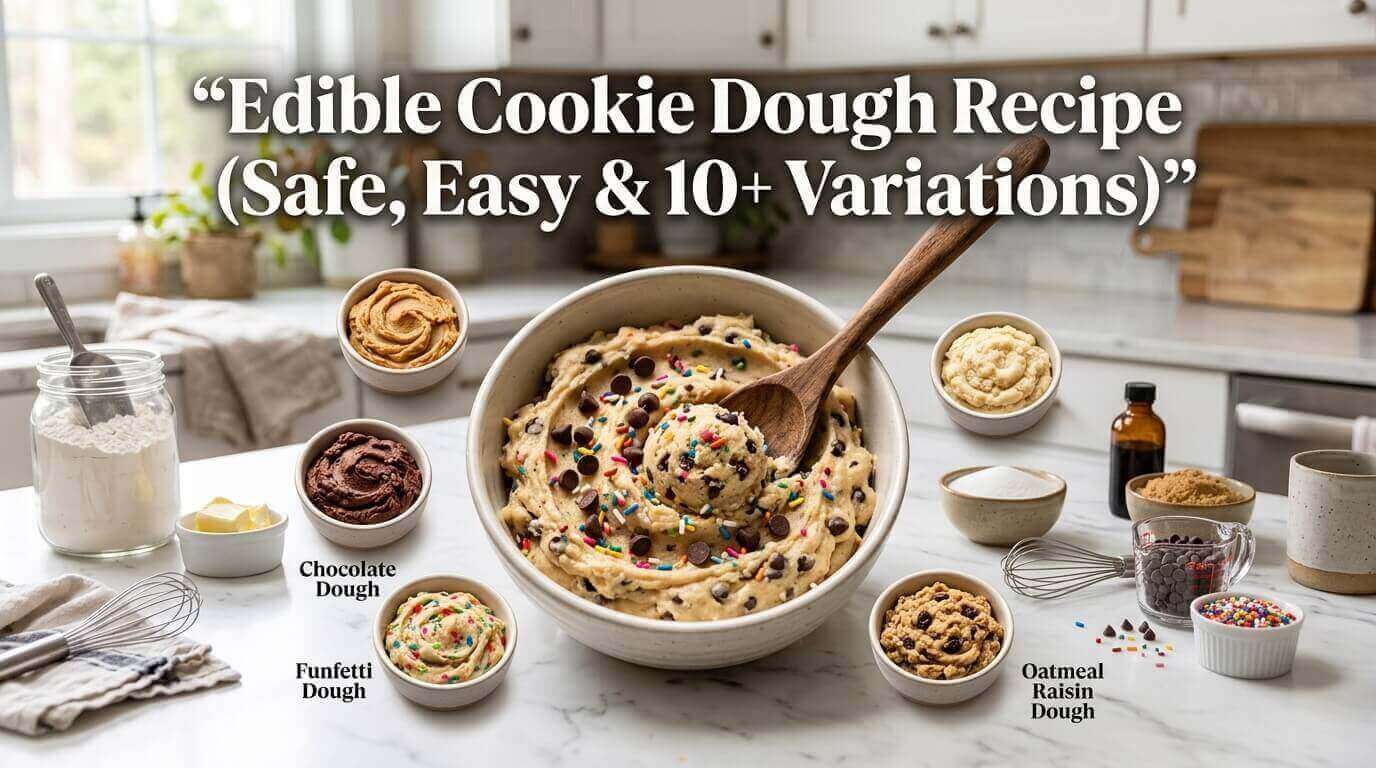
Edible cookie dough is eggless, heat-treated flour-based dough safe for raw consumption. This recipe eliminates Salmonella risk (no raw eggs) and E. coli risk (flour heated to 165°F). Total preparation time is 15 minutes, yielding 8 servings.
This guide provides the classic chocolate chip recipe, single-serving measurements, 10 flavor variations, two heat-treatment methods, storage guidelines, and troubleshooting solutions.
What Makes Cookie Dough Safe to Eat?
Two modifications make cookie dough safe: removing raw eggs and heat-treating flour to 165°F (74°C).
Raw eggs carry Salmonella bacteria. Raw flour harbors E. coli because grain receives no pathogen-killing treatment before milling. The FDA confirms raw flour is a raw agricultural product requiring heat treatment before raw consumption. (FDA Consumer Updates)
The CDC documented a 2019 E. coli outbreak affecting 21 people across 9 states, linked to raw flour consumption. (CDC Outbreak Investigation)
This recipe solves both risks:
- Zero eggs = Zero Salmonella exposure
- Flour heated to 165°F = Zero E. coli exposure
Key Fact: The USDA recommends 165°F as the safe internal temperature for killing harmful bacteria in poultry and flour. (USDA Food Safety)
Edible Cookie Dough Ingredients
Eight ingredients create this eggless cookie dough:
| Ingredient | Amount (Volume) | Amount (Weight) | Function |
|---|---|---|---|
| All-purpose flour | 1½ cups | 180g | Structure base (heat-treat first) |
| Unsalted butter | ½ cup | 113g | Fat content, flavor |
| Light brown sugar | ¾ cup, packed | 150g | Sweetness, molasses depth |
| Granulated sugar | ¼ cup | 50g | Sweetness, slight texture |
| Vanilla extract | 1 tsp | 5ml | Flavor enhancement |
| Salt | ½ tsp | 3g | Flavor balance |
| Milk | 1-3 Tbsp | 15-45ml | Binding agent |
| Mini chocolate chips | 1 cup | 180g | Mix-in |
5 Ingredient Preparation Tips
- Butter temperature: Use room-temperature butter (65-68°F). Properly softened butter holds a fingerprint indent while feeling cool. Melted butter creates greasy dough.
- Brown sugar measurement: Pack brown sugar firmly into measuring cups. Loosely measured brown sugar reduces sweetness by 15-20%.
- Chocolate chip selection: Mini chocolate chips distribute 40% more evenly throughout dough than standard chips. They also bite easier when dough is chilled.
- Milk addition: Start with 1 tablespoon. Add additional milk only when dough appears dry. Whole milk, 2%, almond milk, and oat milk all function identically.
- Flour measurement: Spoon flour into measuring cups, then level with a knife. Scooping directly from the bag compacts flour, adding 25% excess.
How to Heat-Treat Flour: 2 Methods
Heat-treating flour to 165°F (74°C) kills E. coli and other harmful bacteria. Two methods achieve this temperature:
Oven Method (5-7 Minutes)
- Preheat oven to 350°F (175°C)
- Line baking sheet with parchment paper
- Spread 2 cups flour in thin, even layer (extra ½ cup accounts for discarded edges)
- Bake 5-7 minutes, stirring once at 3-minute mark
- Insert instant-read thermometer into flour center
- Confirm temperature reaches 165°F minimum
- Cool flour completely (10-15 minutes) before use
Microwave Method (1-2 Minutes)
- Place 2 cups flour in microwave-safe bowl
- Microwave 30 seconds on high
- Stir flour thoroughly
- Repeat 30-second bursts with stirring
- Check temperature after each burst
- Stop when thermometer reads 165°F
- Spread on plate to cool completely
| Method | Total Active Time | Best Application | Risk Factor |
|---|---|---|---|
| Oven | 5-7 minutes | Large batches, even heating | Minimal burning risk |
| Microwave | 1-2 minutes | Single batches, no preheating | Higher burning risk at edges |
Post-Heat-Treatment Steps
Sift the cooled flour before adding to dough. Heat treatment causes clumping in 80% of batches. Sifting removes lumps and aerates flour for smooth texture.
Cool flour completely before mixing. Warm flour (above 80°F) melts butter on contact, creating greasy, unworkable dough.
Critical Safety Note: Visual indicators (browning, steam) do not confirm safe temperatures. Only thermometer readings verify pathogen elimination.
How to Make Edible Cookie Dough
Prep Time: 10 minutes | Heat-Treat Time: 7 minutes | Total: 17 minutes | Yield: 8 servings (2 cups)
Step 1: Cream Butter and Sugars (2-3 Minutes)
Combine ½ cup softened butter, ¾ cup packed brown sugar, and ¼ cup granulated sugar in large mixing bowl. Beat with electric mixer on medium-high speed for 2-3 minutes.
Target result: Mixture becomes pale, increases in volume by 30%, and develops fluffy texture. Creaming incorporates air and dissolves sugar crystals.
Step 2: Add Wet Ingredients (30 Seconds)
Add 1 teaspoon vanilla extract and ½ teaspoon salt. Beat 30 seconds until combined. Add 1 tablespoon milk and mix briefly.
Step 3: Incorporate Heat-Treated Flour
Add 1½ cups cooled, sifted heat-treated flour gradually. Mix on low speed until just combined. Dough appears slightly crumbly initially—this is expected.
Step 4: Adjust Texture
Evaluate dough consistency:
- Dry/crumbly dough: Add milk in 1-tablespoon increments until dough holds together
- Soft/sticky dough: Refrigerate 10-15 minutes to firm
Most batches require 2-3 tablespoons milk total. Humidity and flour measurement affect exact amount.
Step 5: Fold in Chocolate Chips
Use rubber spatula to fold 1 cup mini chocolate chips into dough. Distribute chips evenly throughout.
Finished texture: Soft, scoopable, holds shape when pressed. Not sticky, not crumbly, not greasy.
Single-Serving Edible Cookie Dough Recipe
This scaled recipe yields one 80-100g serving in 5 minutes.
| Ingredient | Single-Serving Amount |
|---|---|
| Heat-treated flour | 3 Tbsp (24g) |
| Softened butter | 1½ Tbsp (21g) |
| Brown sugar, packed | 2 Tbsp (25g) |
| Granulated sugar | 1 Tbsp (12g) |
| Vanilla extract | ⅛ tsp |
| Salt | Tiny pinch |
| Milk | 1 tsp (if needed) |
| Mini chocolate chips | 2 Tbsp (20g) |
Single-Serving Instructions
- Combine butter, brown sugar, and granulated sugar in small bowl
- Mix with fork until smooth (1 minute)
- Add vanilla, salt, and heat-treated flour
- Stir until combined
- Add milk 1 teaspoon at a time if dry
- Fold in chocolate chips
- Consume immediately
Nutrition per single serving: Approximately 350-400 calories, 18g fat, 45g carbohydrates, 3g protein.
10 Edible Cookie Dough Variations
1. Classic Chocolate Chip
Use base recipe with 1 cup mini semisweet chocolate chips.
2. Sugar Cookie Dough
- Replace ¾ cup brown sugar with ¾ cup additional granulated sugar (1 cup total)
- Add ¼ teaspoon almond extract
- Omit chocolate chips or substitute ½ cup rainbow sprinkles
3. Funfetti Cookie Dough
- Add ½ cup rainbow jimmie sprinkles to base recipe
- Add ½ cup white chocolate chips (optional)
- Include ¼ teaspoon almond extract
4. Peanut Butter Cookie Dough
- Add ¼ cup creamy peanut butter during butter-sugar creaming
- Increase milk to 3-4 tablespoons (peanut butter thickens dough)
- Use ½ cup peanut butter chips and ½ cup chocolate chips
5. Double Chocolate Cookie Dough
- Reduce flour to 1¼ cups
- Add ¼ cup unsweetened cocoa powder
- Use 1 cup mixed milk and dark chocolate chips
- Add ⅛ teaspoon espresso powder for depth (optional)
6. Monster Cookie Dough
- Use ¾ cup heat-treated flour plus ¾ cup heat-treated quick oats
- Add ¼ cup peanut butter during creaming
- Replace chocolate chips with 1 cup mini M&Ms
7. Cookies and Cream (Oreo)
- Add 1 cup crushed Oreo pieces (approximately 10 cookies)
- Reduce chocolate chips to ½ cup or omit entirely
8. Snickerdoodle Cookie Dough
- Use sugar cookie base (no brown sugar)
- Add 1 teaspoon ground cinnamon to dough
- Roll finished dough into balls
- Coat in 2 tablespoons cinnamon-sugar mixture
9. Pumpkin Spice Cookie Dough
- Add 2 tablespoons pumpkin puree to wet ingredients
- Reduce milk by 1 tablespoon (pumpkin adds moisture)
- Add 1 teaspoon pumpkin pie spice
- Use ¾ cup white chocolate chips
10. Brown Butter Cookie Dough
- Brown butter in saucepan until golden with nutty aroma (3-4 minutes)
- Refrigerate browned butter until solid (30-45 minutes)
- Proceed with base recipe using browned butter
- Top with flaky sea salt
Troubleshooting: 5 Common Problems and Solutions
Problem 1: Dry, Crumbly Dough
Causes: Excess flour, compacted flour measurement, over-heated flour
Solution: Add milk in 1-tablespoon increments, mixing after each addition, until dough holds together when pressed.
Prevention: Spoon flour into measuring cups and level with knife. Avoid scooping from bag.
Problem 2: Soft, Sticky Dough
Causes: Butter too warm, excess milk, warm flour added
Solution: Refrigerate dough 15-20 minutes. Add 1-2 tablespoons heat-treated flour if still sticky after chilling.
Prevention: Use properly softened butter (cool to touch, holds fingerprint). Add milk gradually.
Problem 3: Greasy Dough
Causes: Melted butter instead of softened, warm flour melting butter
Solution: Refrigerate dough to solidify butter. Texture improves but may not achieve ideal consistency.
Prevention: Soften butter at room temperature 1-2 hours. Never microwave butter. Ensure flour is completely cool before adding.
Problem 4: Grainy Texture
Causes: Undissolved sugar during creaming
Solution: Grainy texture cannot be fixed after mixing. Consume as-is or remake.
Prevention: Cream butter and sugars for full 2-3 minutes until completely smooth and pale.
Problem 5: Raw Flour Taste
Causes: Flour not heated to 165°F
Solution: Flour requires re-heat-treatment. Do not consume dough made with underheated flour.
Prevention: Always verify flour temperature with instant-read thermometer. Visual cues are unreliable.
How to Store Edible Cookie Dough
Proper storage maintains freshness and food safety:
| Storage Location | Container Type | Maximum Duration | Serving Preparation |
|---|---|---|---|
| Refrigerator | Airtight container | 5-7 days | Rest at room temperature 10-15 minutes |
| Freezer | Airtight container or freezer bag | 3 months | Thaw overnight in refrigerator |
4 Storage Best Practices
- Surface protection: Press plastic wrap directly onto dough surface before sealing container. Prevents surface drying.
- Portion before freezing: Roll dough into 1-tablespoon balls before freezing. Allows single-serving retrieval without thawing entire batch.
- Layer separation: Place parchment paper between dough ball layers. Prevents freezing together.
- Date labeling: Mark container with preparation date. Discard refrigerated dough after 7 days and frozen dough after 3 months.
Expected texture change: Refrigerated dough firms significantly. This is normal. Room-temperature resting restores soft, scoopable texture.
8 Ways to Use Edible Cookie Dough
- Ice cream topping: Add 2-tablespoon scoops to vanilla or chocolate ice cream bowls
- Cookie dough truffles: Roll into 1-inch balls, dip in melted chocolate, chill on parchment 15 minutes
- Milkshake mix-in: Blend ¼ cup dough with 2 scoops vanilla ice cream and ½ cup milk
- Yogurt parfait: Layer dough pieces with Greek yogurt and granola
- Cupcake filling: Remove 1-tablespoon center from baked cupcakes, fill with cookie dough
- Cake layer filling: Spread ½-inch layer between cake layers
- Dessert dip: Serve dough in bowl with graham crackers, pretzels, or apple slices
- Gift jars: Package ½-cup portions in mason jars with ribbon for gifts
Can You Bake Edible Cookie Dough?
No. This recipe is formulated exclusively for raw consumption.
Three factors prevent successful baking:
- No eggs: Eggs provide structure and binding in baked cookies. Without eggs, baked results are flat and crumbly.
- Altered ratios: Butter-to-flour-to-sugar proportions are optimized for raw texture, not baking chemistry.
- No leavening: Traditional cookies require baking soda or baking powder. This recipe contains neither.
Baking this dough produces flat, dense, greasy results that spread excessively and lack structural integrity.
Alternative: Use traditional chocolate chip cookie recipes containing eggs and leavening for bakeable dough.
Frequently Asked Questions
Is edible cookie dough safe during pregnancy?
Yes, when prepared correctly. Edible cookie dough made with heat-treated flour (165°F minimum) and no raw eggs eliminates Salmonella and E. coli risks. The CDC and FDA identify these as the primary raw dough hazards. Consult your healthcare provider for individual dietary guidance during pregnancy.
How long does edible cookie dough last?
Edible cookie dough remains safe for 5-7 days in refrigerated airtight containers and 3 months in freezer storage. Check for off odors, discoloration, or mold before consuming stored dough. Discard dough exceeding these timeframes.
Why must flour be heat-treated?
Raw flour contains E. coli bacteria because grain receives no pathogen-killing treatment during growing, harvesting, or milling. The FDA classifies flour as a raw agricultural product requiring cooking before consumption. Heat-treating to 165°F eliminates these harmful bacteria. (FDA Raw Dough Safety)
Can I substitute almond flour?
Yes. Almond flour is safe for raw consumption without heat treatment. Use 1:1 substitution for gluten-free edible cookie dough. Expect softer texture and subtle nutty flavor. Other options: heat-treated oat flour or 1:1 gluten-free flour blends (Bob’s Red Mill).
What distinguishes edible cookie dough from regular cookie dough?
Edible cookie dough contains no raw eggs and uses heat-treated flour, eliminating Salmonella and E. coli risks. Regular cookie dough contains raw eggs and untreated flour, making raw consumption unsafe. Edible recipes also use different butter-flour-sugar ratios optimized for raw texture rather than baking performance.
Is Nestlé Toll House or Pillsbury cookie dough safe to eat raw?
Traditional refrigerated versions: No. Standard Nestlé Toll House and Pillsbury refrigerated doughs contain raw eggs and untreated flour. Labeled “edible” versions: Yes. Both brands now offer specifically labeled safe-to-eat-raw products with heat-treated flour and no eggs. Check package labels—products stating “do not consume raw dough” are unsafe unbaked.
How do I confirm flour reached safe temperature?
Insert instant-read thermometer into center of flour pile. Temperature must read 165°F (74°C) minimum. Visual indicators (browning, steam, color change) do not confirm pathogen elimination. Thermometer verification is the only reliable safety confirmation method.
Why does my edible cookie dough lack sweetness?
Three common causes: Loosely measured brown sugar (pack firmly), using salted butter without sugar adjustment, or using light brown sugar when recipe specifies dark. Solution: Taste dough before adding chocolate chips. Mix in 1-2 additional tablespoons of either sugar if needed.
What ingredients make edible cookie dough?
Eight ingredients comprise basic edible cookie dough: heat-treated all-purpose flour, softened unsalted butter, packed brown sugar, granulated sugar, vanilla extract, salt, milk, and chocolate chips. Unlike regular cookie dough, no eggs are included. Flour requires heat-treatment to 165°F before use.
Is edible cookie dough healthy?
Edible cookie dough is a treat, not a health food. One serving (approximately ¼ cup) contains 400-450 calories, 19g saturated fat, and 42g sugar. It provides minimal protein, fiber, or vitamins. Healthier alternatives include recipes using Greek yogurt, oat flour, or reduced sugar. Consume in moderation as part of balanced diet.
Complete Recipe Card
Prep Time: 10 minutes
Cook Time: 7 minutes (flour heat-treatment)
Total Time: 17 minutes
Yield: 8 servings (approximately 2 cups)
Calories: 420 per serving
Ingredients
- 1½ cups (180g) all-purpose flour, heat-treated to 165°F
- ½ cup (113g) unsalted butter, softened to room temperature
- ¾ cup (150g) light brown sugar, firmly packed
- ¼ cup (50g) granulated sugar
- 1 tsp vanilla extract
- ½ tsp salt
- 1-3 Tbsp milk
- 1 cup (180g) mini chocolate chips
Equipment
- Large mixing bowl
- Electric mixer (hand mixer or stand mixer)
- Baking sheet with parchment paper
- Instant-read thermometer
- Rubber spatula
- Measuring cups and spoons
- Airtight storage container
Instructions
- Heat-treat flour: Preheat oven to 350°F. Spread 2 cups flour on parchment-lined baking sheet. Bake 5-7 minutes. Verify temperature reaches 165°F with thermometer. Cool completely (10-15 minutes). Sift 1½ cups into bowl, discarding any burned portions.
- Cream butter and sugars: Beat softened butter, brown sugar, and granulated sugar with electric mixer on medium-high for 2-3 minutes until light and fluffy.
- Add wet ingredients: Beat in vanilla extract and salt for 30 seconds. Add 1 tablespoon milk and mix briefly.
- Add flour: Gradually add cooled, sifted flour. Mix on low until just combined. Add additional milk 1 tablespoon at a time if dough is crumbly.
- Add chocolate chips: Fold in mini chocolate chips with rubber spatula until evenly distributed.
- Serve or store: Enjoy immediately or refrigerate in airtight container up to 7 days.
Scaling Guide
| Servings | Flour | Butter | Brown Sugar | Granulated Sugar | Chocolate Chips |
|---|---|---|---|---|---|
| 1 | 3 Tbsp | 1½ Tbsp | 2 Tbsp | 1 Tbsp | 2 Tbsp |
| 4 | ¾ cup | ¼ cup | ⅓ cup + 1 Tbsp | 2 Tbsp | ½ cup |
| 8 | 1½ cups | ½ cup | ¾ cup | ¼ cup | 1 cup |
| 16 | 3 cups | 1 cup | 1½ cups | ½ cup | 2 cups |
Nutrition Facts (Per Serving)
| Nutrient | Amount | % Daily Value |
|---|---|---|
| Calories | 420 | 21% |
| Total Fat | 19g | 24% |
| Saturated Fat | 12g | 60% |
| Cholesterol | 41mg | 14% |
| Sodium | 160mg | 7% |
| Carbohydrates | 58g | 21% |
| Fiber | 1g | 4% |
| Sugar | 42g | — |
| Protein | 4g | 8% |
Key Facts Summary
| Fact | Detail | Source |
|---|---|---|
| Raw flour E. coli risk | Grain untreated before milling | FDA Consumer Updates |
| 2019 flour E. coli outbreak | 21 people across 9 states | CDC Investigation |
| Safe flour temperature | 165°F (74°C) minimum | USDA Food Safety |
| Refrigerator storage duration | 5-7 days maximum | Food safety standards |
| Freezer storage duration | 3 months maximum | Food safety standards |
| Proper butter temperature | 65-68°F (18-20°C) | Baking science |
Related Recipes:
 Easy Homemade Whole Wheat Bread Recipe – Soft & Yummy Made at Home
 Easy Honey Wheat Bread Recipe: The Best Homemade Bread for Kids
 The BEST Whole Wheat Bread Machine Recipe (Super Easy!)
 How to Make Yummy Whole Wheat Sourdough Bread (It’s Easier Than You Think!)
 Soft and Yummy Whole Wheat Sandwich Bread Recipe (Must Try!)
 Easy Authentic Rougamo Bread Recipe: The Crispy Chinese Flatbread 2025 Recipe
 Bread Flour vs All-Purpose Flour: What’s the Difference?
 King Arthur Gluten-Free Sourdough Bread Recipe
 Easy Homemade Ezekiel Bread Recipe: Sprouted & Nutritious
 Easy Homemade Garlic Bread from Scratch with All-Purpose Flour
 Best Garlic Bread Recipe from Scratch: Step by Step Guide
 Leavened vs Unleavened Bread: Complete Guide | Differences & Example
 Ultimate Double Chocolate Sourdough Bread Recipe
 Double Chocolate Espresso Sourdough Bread Recipe: Step by Step Guide
 Step by Step 7 Brew Banana Bread Blondie Recipe
 Cookie Dough Banana Bread: The Ultimate Bakery-Style Recipe
 Martha Stewart Banana Bread Recipe (The Best You’ll Ever Make)
 Martha Stewart Sour Cream Banana Bread (Ultra-Moist Recipe)
 Martha Stewart Buttermilk Banana Bread Recipe (No Sour Cream Needed)
 Martha Stewart Chocolate Chip Banana Bread (Gooey & Perfect)
 Martha Stewart Banana Nut Bread (Crunchy Walnuts, Perfect Texture)